We may earn a commission when you buy through our links. Learn more
Contents
Yes, for the part that uses electricity. A gas furnace burns gas for heat; electricity runs the blower, the inducer fan and the controls. The US Department of Energy uses 382 W at heating speed for a baseline furnace blower, within the continuous output of every station of 500 W and up. But a furnace is wired into the house, so connecting it needs an approved transfer device installed by a licensed electrician.
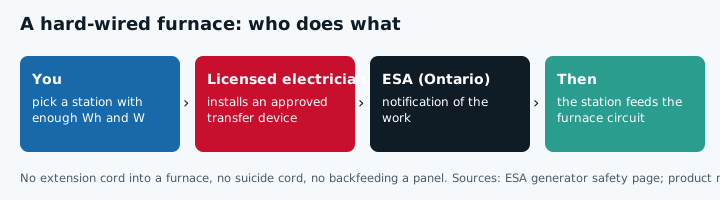
Hard-wired appliances need an electrician. A gas furnace, a well pump or anything else wired into your panel is never fed by an extension cord or a "suicide cord", and never by plugging a station or a generator into a wall outlet. The only safe route is an approved transfer device installed by a licensed electrical contractor. In Ontario, the Electrical Safety Authority says a generator permanently connected to your wiring "must have a transfer device", that you "must file a notification of work with ESA", and it "strongly recommends hiring a Licensed Electrical Contractor" (ESA, Generator Safety, read Nov 14, 2026). Other provinces have their own electrical safety regulator: ask yours. We give no wiring instructions.
How many hours of furnace per station
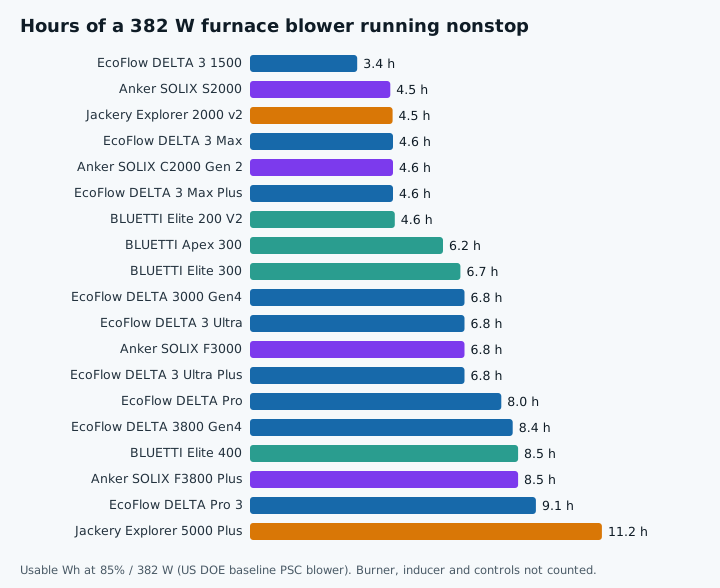
The blower runs only when the thermostat calls for heat, more often as it gets colder. The table gives two views: the blower running nonstop (worst case), and days if it runs 8 hours a day (an assumption; set your own hours in What will it run, and for how long). Burner controls, inducer and igniter add to this and are not in the DOE figure.
| Station | Price | Usable Wh at 85% [calc] | Blower running nonstop [calc] | Blower 8 h a day: days [calc] | Continuous output |
|---|---|---|---|---|---|
| BLUETTI AC70 | CA$449 | 653 | 1.7 h | 0.2 | 1,000 W |
| EcoFlow RIVER 2 Pro | CA$499 | 653 | 1.7 h | 0.2 | 800 W |
| EcoFlow DELTA 3 1000 Air | CA$499 | 816 | 2.1 h | 0.3 | 500 W |
| BLUETTI Elite 100 Mini | CA$549 | 853 | 2.2 h | 0.3 | 700 W |
| EcoFlow DELTA 2 | CA$599 | 870 | 2.3 h | 0.3 | 1,800 W |
| Anker SOLIX C1000 Gen 2 | CA$649 | 870 | 2.3 h | 0.3 | 2,000 W |
| BLUETTI Elite 100 V2 | CA$649 | 870 | 2.3 h | 0.3 | 1,800 W |
| EcoFlow DELTA 3 Classic | CA$699 | 870 | 2.3 h | 0.3 | 1,800 W |
| ALLPOWERS R1500 LITE | CA$374.90 | 898 | 2.3 h | 0.3 | 1,600 W |
| Jackery Explorer 1000 v2 | CA$649 | 910 | 2.4 h | 0.3 | 1,500 W |
| BLUETTI AC180T | CA$1,199 | 1,218 | 3.2 h | 0.4 | 1,800 W |
| EcoFlow DELTA 3 1500 | CA$1,099 | 1,306 | 3.4 h | 0.4 | 1,800 W |
| Anker SOLIX S2000 | CA$849 | 1,708 | 4.5 h | 0.6 | 1,500 W |
| Jackery Explorer 2000 v2 | CA$1,099 | 1,736 | 4.5 h | 0.6 | 2,200 W |
| EcoFlow DELTA 3 Max | CA$989 | 1,741 | 4.6 h | 0.6 | 2,400 W |
| Anker SOLIX C2000 Gen 2 | CA$1,099 | 1,741 | 4.6 h | 0.6 | 2,400 W |
| EcoFlow DELTA 3 Max Plus | CA$1,299 | 1,741 | 4.6 h | 0.6 | 3,000 W |
| BLUETTI Elite 200 V2 | CA$1,079 | 1,763 | 4.6 h | 0.6 | 2,600 W |
| BLUETTI Apex 300 | CA$1,799 | 2,350 | 6.2 h | 0.8 | 3,840 W |
| BLUETTI Elite 300 | CA$1,699 | 2,562 | 6.7 h | 0.8 | 2,400 W |
| EcoFlow DELTA 3000 Gen4 | CA$1,599 | 2,611 | 6.8 h | 0.9 | 3,600 W |
| EcoFlow DELTA 3 Ultra | CA$1,599 | 2,611 | 6.8 h | 0.9 | 3,600 W |
| Anker SOLIX F3000 | CA$1,899 | 2,611 | 6.8 h | 0.9 | 3,600 W |
| EcoFlow DELTA 3 Ultra Plus | CA$1,999 | 2,611 | 6.8 h | 0.9 | 3,600 W |
| EcoFlow DELTA Pro | CA$1,999 | 3,060 | 8.0 h | 1.0 | 3,600 W |
| EcoFlow DELTA 3800 Gen4 | CA$2,499 | 3,199 | 8.4 h | 1.0 | 3,600 W |
| BLUETTI Elite 400 | CA$1,899 | 3,264 | 8.5 h | 1.1 | 2,600 W |
| Anker SOLIX F3800 Plus | CA$3,199 | 3,264 | 8.5 h | 1.1 | 6,000 W |
| EcoFlow DELTA Pro 3 | CA$2,799 | 3,482 | 9.1 h | 1.1 | 4,000 W |
| Jackery Explorer 5000 Plus | CA$3,899 | 4,284 | 11.2 h | 1.4 | 7,200 W |
What to check on your furnace
- The rating plate: volts, amps (or watts) of the blower motor, and whether it is a PSC or ECM motor.
- The manual: starting current, if published. Enter it as starting watts in What will it run, and for how long to test each station's surge.
- Your thermostat and controls: furnace electronics expect clean 120 V power, so check that the station's page or manual describes a pure sine wave output.
And a small electric heater?
Possible, briefly. Usable Wh divided by the heater's label watts: a heater labelled 1,500 W takes the 1,741 usable Wh of a 2,048 Wh station in a little over an hour [calc]. For heat through an outage, the gas furnace's blower is the far smaller load. Compare stations in the power station comparison for Canada.
Frequently asked questions
How many watts does a gas furnace use?
Mostly the blower fan. The US Department of Energy uses 382 W at heating speed for a baseline 3-ton furnace with a PSC motor. Furnaces with an ECM motor generally use less; the exact figure is on your furnace's rating plate or in its manual.
Can I plug my furnace into a power station?
Not with an extension cord or by back-feeding an outlet. A furnace is wired into the house. It needs an approved transfer device installed by a licensed electrical contractor (in Ontario, with a notification to ESA). Some brands sell transfer switches; installation is still an electrician's job.
How long will a power station run a small heater?
Divide usable watt-hours by the heater's label watts. A heater labelled 1,500 W on a 2,048 Wh station at 85% runs about 1.2 hours [calc]; a 3,072 Wh station, about 1.7 hours. Electric heat empties a battery fast: the furnace blower uses about a quarter of that power.