We may earn a commission when you buy through our links. Learn more
Tick what must keep running, set how long the power stays off, and the calculator checks the 39 stations we read at the official Canadian stores on November 14, 2026: enough usable energy, enough continuous output, and, if you give it, enough surge for your biggest motor.
Where each wattage comes from
| Appliance | Figure used | Source |
|---|---|---|
| Gas furnace blower | 382 W at heating speed | US DOE, furnace fan energy appendix 7-C: "382 watts at heating" for the 3-ton baseline PSC motor of a non-condensing gas furnace. Burner controls, inducer and igniter are not included. |
| Sump pump | 1,116 W while running [calc] | Zoeller M53 catalogue: "3/10 HP 115 V sump pump", 9.7 A at 115 V; 115 x 9.7 = 1,116 [calc]. Starting draw not published. |
| Refrigerator | 1,320 Wh a day [calc] | Natural Resources Canada, energy consumption of refrigerators: 481.9 kWh a year, average unit shipped in 2020. Older units use more (638.8 kWh for 2000). |
| Freezer | 807 Wh a day [calc] | NRCan, energy consumption of freezers: 294.6 kWh a year, 2020 average. |
| CPAP | 56.1 W typical, 73.2 W peak | ResMed AirSense 11 specifications, with the heated humidifier. |
| Wi-Fi router | 18 W [calc] | TP-Link Archer AX55: "Power 12 V 1.5 A", the adapter's rating, so an upper bound. |
| LED bulb | 8.8 W | Feit Electric 8.8W (60W Replacement) A19. |
| Phone charging | 20 W | Apple 20W USB-C Power Adapter, its maximum. |
How the check works
- Energy. Watts x hours a day x how many, scaled to the outage length; fridge and freezer use their daily figure. A station counts for its published Wh x the efficiency you set (85% by default).
- Continuous output. All the running watts you ticked are added as if they ran at the same moment, the safe assumption. The station's published continuous AC output must cover them.
- Surge. Only checked when you enter starting watts: published surge must cover the running watts plus that start. Stations whose brand page does not publish a surge figure are then set aside, and named under the table.
- Price. The official Canadian store's price on November 14, 2026, including Black Friday sales. A struck price is the store's own.
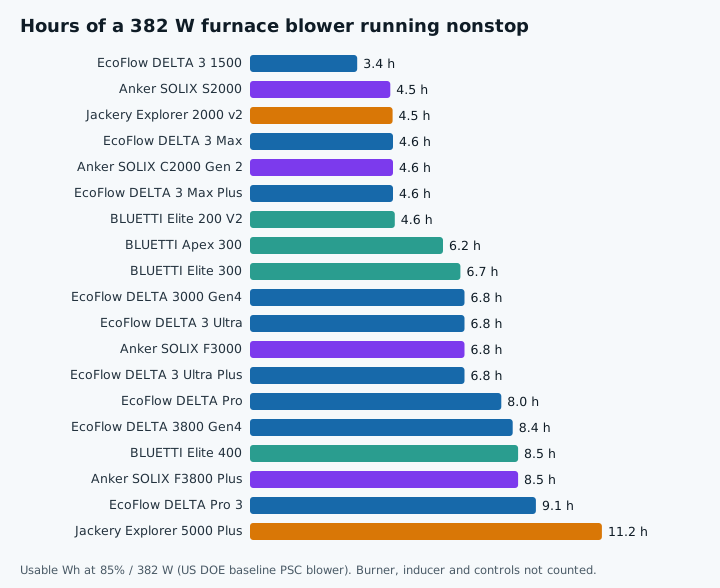
Hard-wired appliances need an electrician. A gas furnace, a well pump or anything else wired into your panel is never fed by an extension cord or a "suicide cord", and never by plugging a station or a generator into a wall outlet. The only safe route is an approved transfer device installed by a licensed electrical contractor. In Ontario, the Electrical Safety Authority says a generator permanently connected to your wiring "must have a transfer device", that you "must file a notification of work with ESA", and it "strongly recommends hiring a Licensed Electrical Contractor" (ESA, Generator Safety, read Nov 14, 2026). Other provinces have their own electrical safety regulator: ask yours. We give no wiring instructions.
Compare prices per usable kWh on the cost and weight table, or see the power station comparison for Canada and its four picks.
Frequently asked questions
Why 85% efficiency?
A station loses energy in its inverter and electronics. ALLPOWERS publishes its own runtime formula with 0.85 ("working time = 288Wh * 0.85 / working power"), and Anker reports 88% for its S2000 against a 78% industry average at a 100 W load. We start at 85%; change it if your station's manual gives another figure.
Why are fridge running watts optional?
Natural Resources Canada publishes what fridges and freezers use per year, which gives the energy per day, but not the watts a compressor draws while running or starting. Those are on the rating plate of your appliance. Enter them to include the fridge in the output check.
What does "starting watts" mean?
Motors in furnace blowers, sump pumps and compressors draw more for a moment when they start. The makers we cite do not publish that figure. If your appliance manual does, enter it: the tool then keeps only stations whose published surge rating covers all running watts plus that start.
Does the calculator connect my furnace?
No. It only adds up energy and power. A furnace or any appliance wired into the house needs an approved transfer device installed by a licensed electrical contractor before any station can feed it.
Keep reading
- Gas furnaceThe watts are easy. The wiring is not yours to do.
- Sump pumpIt depends less on the station than on how often your pump starts.
- FridgeFrom four hours on a pocket station to more than three days.
- Charging in the coldWhat the brands publish, station by station. No extrapolation.
- Ice storm sizeSize it from one day of your house, then count the days.